Hiring Decision Governance.
Structured Evaluation. Traceable Decisions.
RecruitIQ is an AI-enabled enterprise hiring platform designed to structure candidate analysis, evaluations, approvals, and decision records so hiring teams can understand not only where candidates are in the process, but how important hiring decisions are being made.
Most recruitment systems are very good at telling organizations where a candidate is in the funnel. That does not necessarily explain why the candidate moved forward, how reviewers reached their conclusions, where evaluations differed, or how the final decision was justified.
RecruitIQ was designed around that missing decision layer.
Useful for knowing where candidates are.
Necessary for understanding why decisions are being made.
RecruitIQ brings both into the same environment.
Candidate evaluation may involve experience, skills, education, role requirements, interview feedback, assessments, documents, recruiter observations, and hiring-manager judgment.
RecruitIQ brings relevant candidate information into a structured decision context.
When evaluators use different standards, different notes, and different levels of detail, comparisons become difficult and decisions can become inconsistent.
RecruitIQ creates a more structured environment for evaluating candidates against the requirements of the role.
RecruitIQ uses AI to reduce repetitive analysis, structure candidate information, and help evaluators see relevant patterns. Human recruiters, hiring managers, and leaders remain responsible for interpreting the evidence and making employment decisions.
Intelligence supports judgment. It does not replace responsibility.
Important hiring decisions should retain context: who evaluated the candidate, what evidence was considered, what recommendation was made, and how the final decision was reached.
RecruitIQ is designed to preserve more of that decision history.
The process leaves a record.
Recruiting pipelines can contain dozens of active candidates, but the important management question is not only how many candidates exist. It is where evaluation, approvals, scheduling, or decisions are becoming stalled.
Structured approvals can help organizations clarify who is responsible for review and where a decision is waiting.
Decision accountability becomes visible.
Hiring decisions may involve greater expectations around governance, role suitability, documentation, and management oversight.
Firms may need clearer evaluation of specialist experience, role alignment, and decision rationale across multiple reviewers.
More traceable hiring decisions and better-preserved decision context help organizations reconstruct how selections were made.
As hiring volume increases, structured evaluation helps teams maintain consistency and decision quality across recruiters and roles.
Tracks where candidates are.
Helps structure why candidates advance and how decisions are made.
Analyses initial candidate information.
Supports the broader decision journey from candidate understanding through evaluation and decision records.
Automates judgment.
Uses AI to support human evaluation and decision-making.
What evidence supports this evaluation?
Are candidates being assessed consistently?
Where is the decision waiting?
Can we reconstruct why the final decision was made?
Those questions shaped RecruitIQ more than a conventional ATS feature checklist.
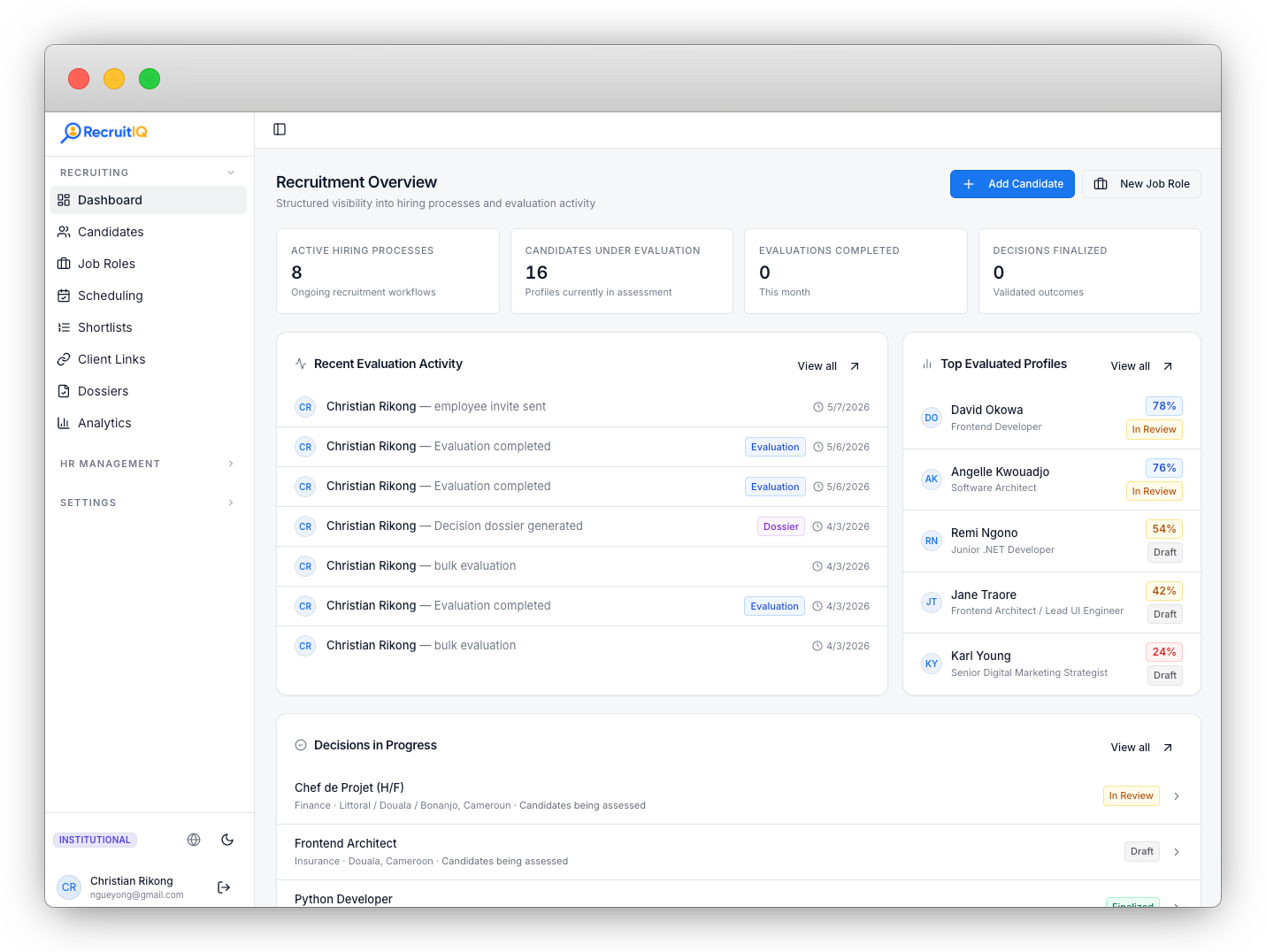
Recruitment Overview — active hiring processes, candidates under evaluation, recent evaluation activity and decisions in progress.
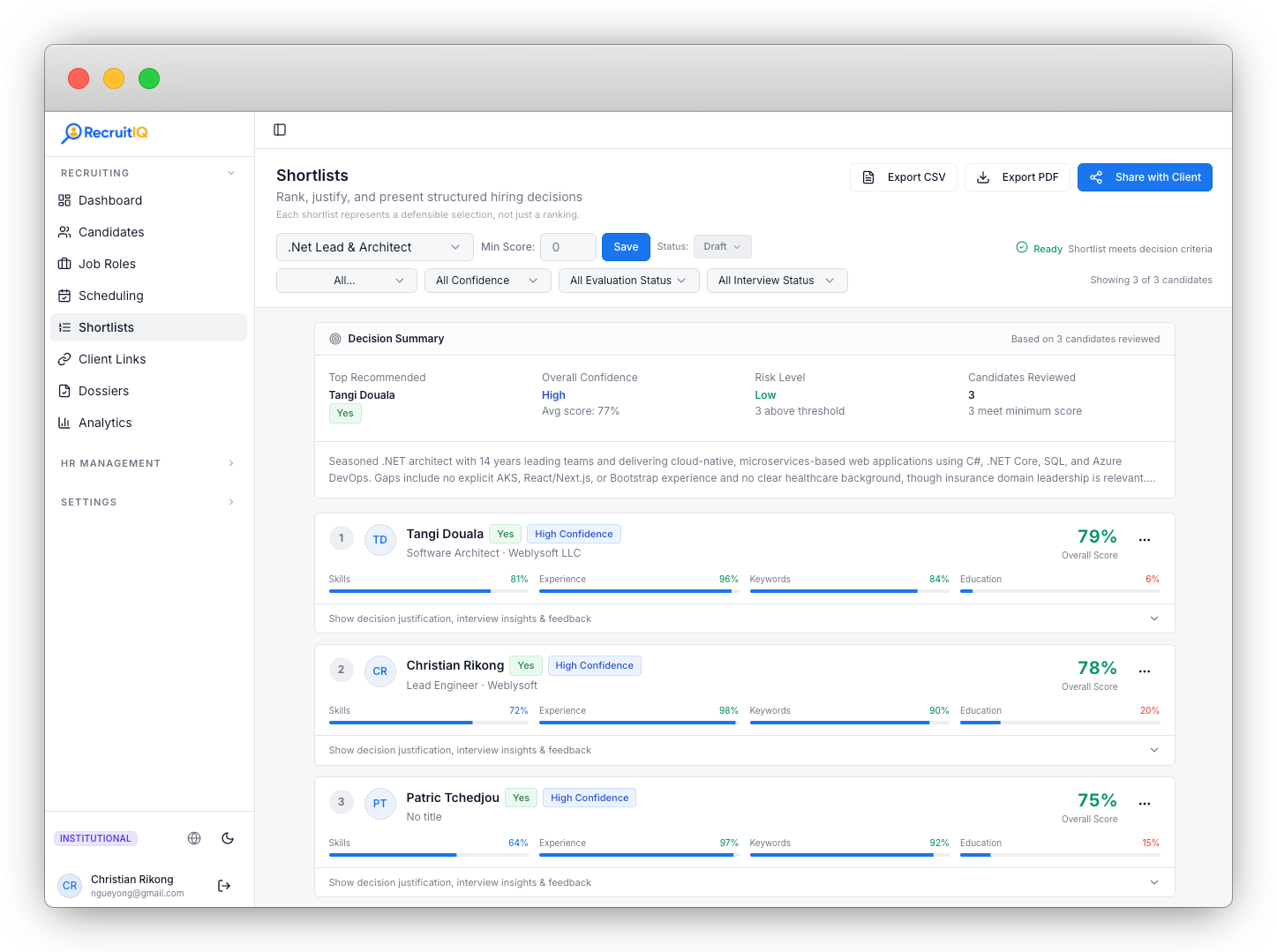
A consistent evaluation environment designed to make comparisons between candidates easier and decisions more grounded in structured evidence.
Hiring leaders see where decisions are advancing, stalling, or waiting — not just where candidates are in a funnel stage.
Every evaluation and review step has an assigned owner. The next action does not disappear between inboxes and meeting notes.
Decision context — who evaluated, what evidence was considered, what recommendation was made — is preserved rather than lost after the final selection.
AI helps structure candidate information and surface relevant patterns. People retain full responsibility for employment decisions.
The Hardest Part Of Hiring Is Not Moving Candidates Through A Funnel.
It Is Making A Decision You Can Explain.
Working through a recruitment, decision-governance, or operational visibility problem? We can help determine what kind of system your organization needs.