Software Your IT Team Will Be Glad to Inherit.
We design software with clear responsibilities, deliberate architectural decisions, and the people who will maintain it in mind. From integration and security to testing and documentation, we plan for what happens after launch.
ArchitectureSecurityIntegrationMaintainability
Engineering You Can Hand Over.
Software shouldn't become a mystery when the original development team steps away. We structure projects so that the relevant technical decisions, application components, and operational requirements can be understood by the people responsible for maintaining them.
Architecture documentation
System components, their responsibilities and dependencies, and the significant design decisions with the reasons behind them.
Source code and repository
A readable repository structure, consistent conventions and setup instructions a new developer can follow.
Data models
Entities, relationships, ownership of each record type and how schema changes are applied.
API and integration notes
Endpoints, request and response shapes, validation rules, error behaviour and the external systems each interface depends on.
Deployment documentation
Environments, configuration (without the secrets themselves), build and release steps, and how to roll back.
Testing documentation
What is covered by automated tests, how to run them and which workflows are checked manually before release.
Operational runbooks
Routine tasks, known failure modes, where logs live and who to contact when something needs attention.
- Scope note
Documentation, repository access, deployment responsibilities, and handover materials are defined according to the project's scope and agreement. Not every engagement includes every item above.
How the Pieces Fit Together.
Enterprise applications rarely operate alone. They connect users, workflows, business rules, existing systems, and data. We design these responsibilities explicitly so the application can evolve without unnecessary coupling.
Identity and security
- Authentication
- Role and permission checks
- Secrets handling
- Audit events
Experience
- Public website
- Staff portals
- Client interfaces
- Admin and content tools
Application services
- Business rules
- Workflow logic
- Input validation
- Authorization decisions
Data and documents
- Relational records
- Files and documents
- Approved knowledge sources
External integrations
- Existing business systems
- Identity providers
- Third-party services
Operations
- Logs and traces
- Monitoring
- Backups
- Releases and rollback
How the areas relate
- Experience to services. In this reference, interfaces call application services through defined APIs. Presentation checks help users; authoritative business rules stay in the services, not in the browser.
- Services own the rules. Validation, workflow state and permission decisions happen server-side, so every interface gets the same behaviour.
- Services own the data. Records and documents are written through the services that own them, which keeps the data model changeable.
- Integrations go through adapters. External systems exchange data through an interface with mapping and validation, never through unrestricted database access.
- Identity applies everywhere. Who is calling, and what they may do, is checked at each boundary rather than once at the front door.
- Operations supports each layer. Useful logs and health signals support monitoring, incident review and release checks. Their scope and retention must respect data sensitivity and access requirements.
Technology Choices Follow the Problem.
We evaluate technology choices against the application's requirements, existing infrastructure, security needs, integration constraints, team capabilities, and long-term maintenance considerations. The goal is an appropriate design, not a fashionable technology stack.
That means no default to microservices, serverless, Kubernetes or a particular cloud. A well-structured single application is often the right answer.
Engineering in Practice.
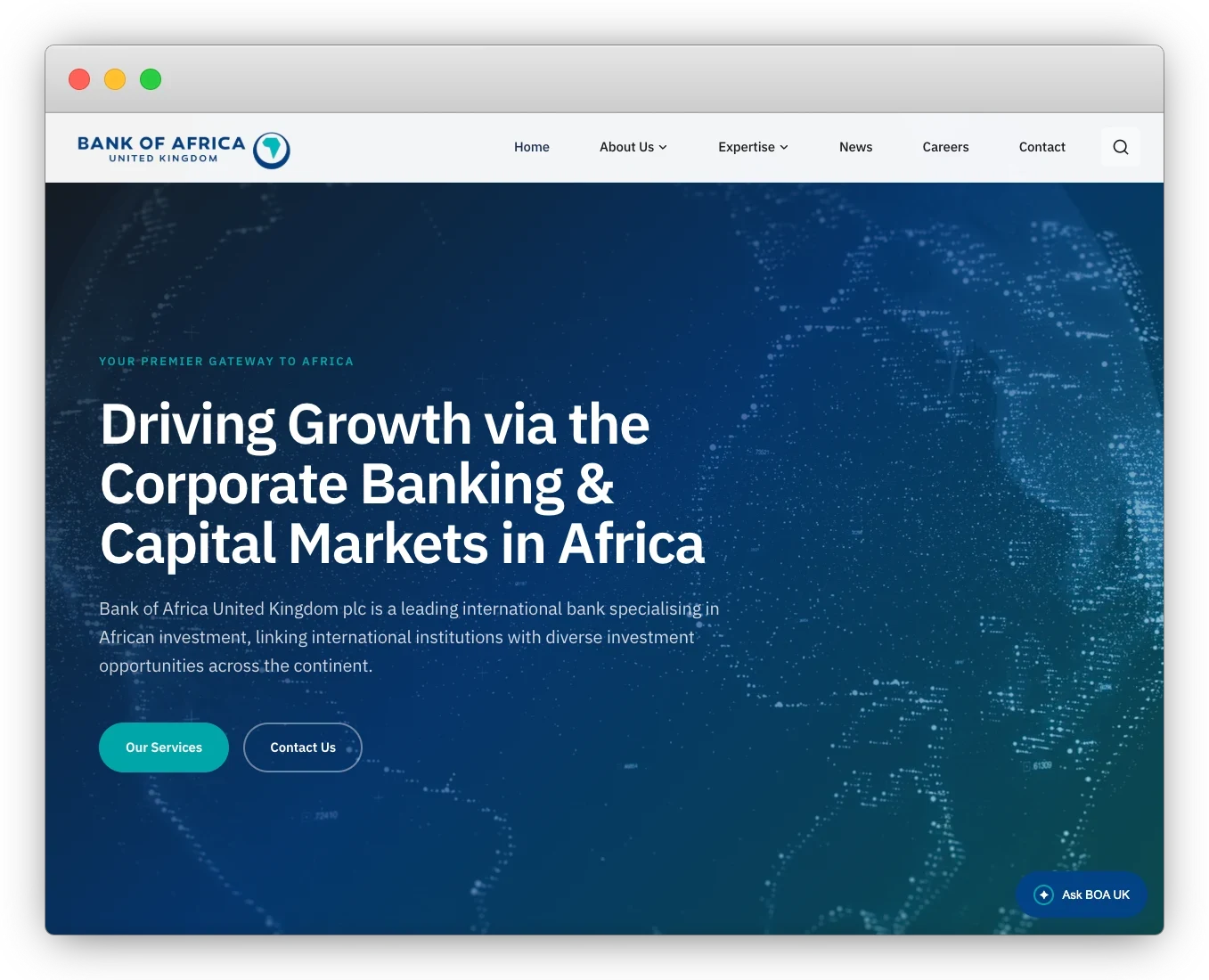
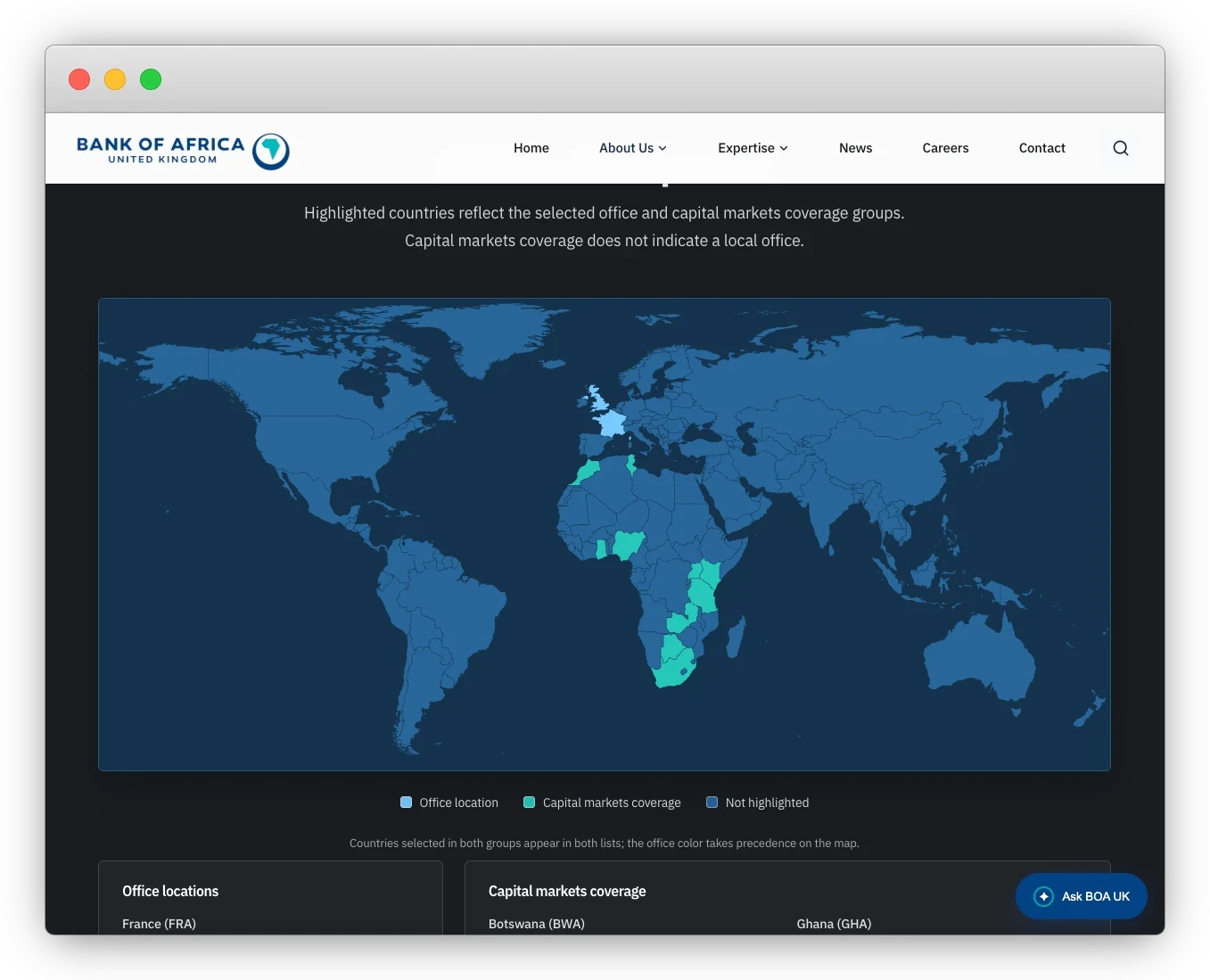
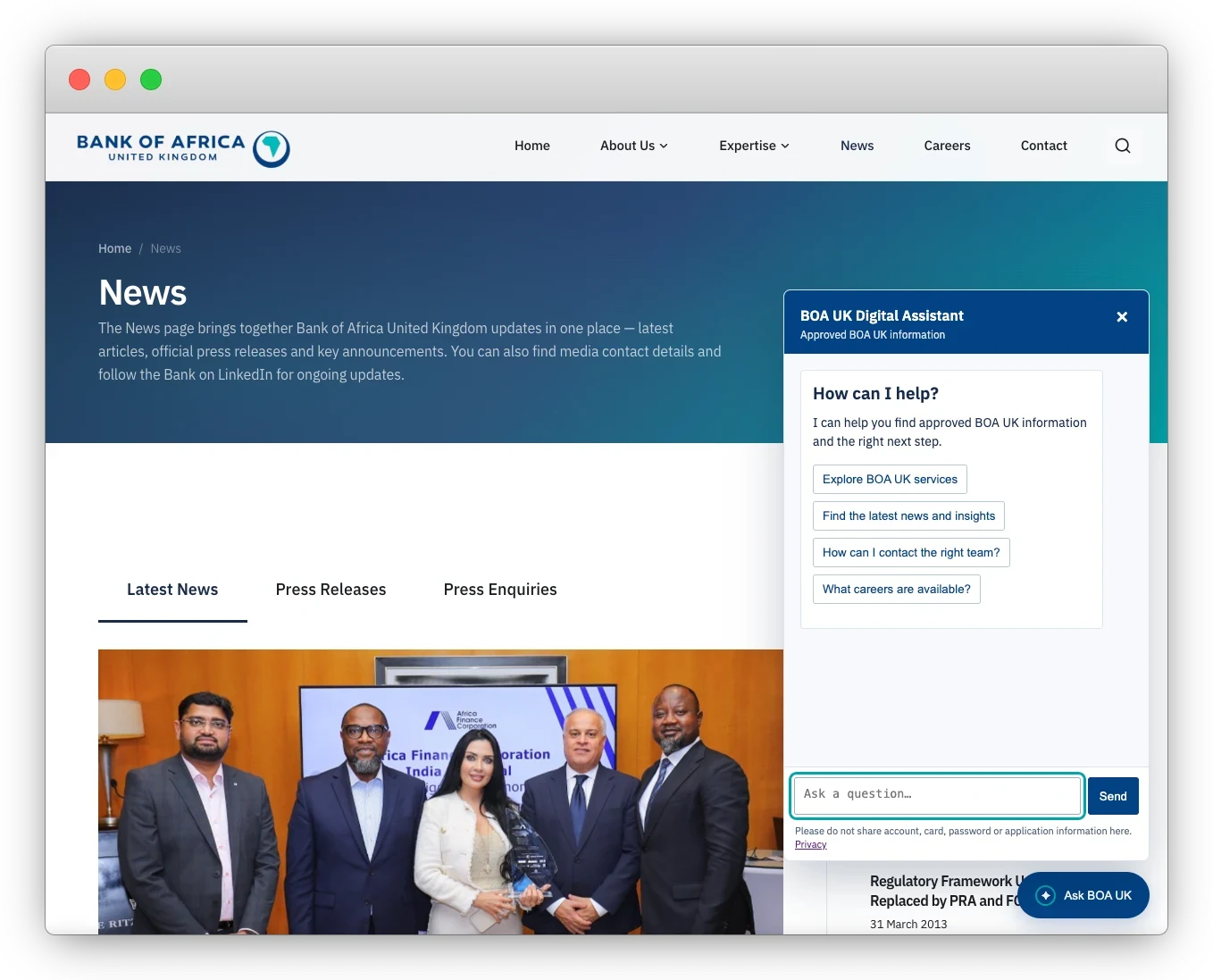
One public example: Bank of Africa United Kingdom. What we were responsible for, what the interfaces show, and where the published evidence stops.
- Context
- The institution needed a corporate website that communicates institutional information, keeps content under its own editorial control, and helps visitors find what they need.
- Our responsibilities
- Experience design and responsive front end
- Content-management interface, tools and structured content blocks
- Visitor-facing assistant interface linked to managed sources
- Public coverage interface
- Delivered capabilities
- Corporate information, content administration, geographic coverage information and visitor assistance.
- Technology
- The project historically used Umbraco for content management.
The project shown demonstrates the public interfaces we delivered. Its full implementation topology, hosting and current platform versions are not published here, and the reference architecture above is not a diagram of this system.
Engineering for the Life of the Software.
Software quality is shaped by decisions made before development, during implementation, and after deployment. We consider maintainability, testing, integration, security, and operational responsibilities throughout the project.
- 01
Architecture and design
We map responsibilities, data ownership and integration points before writing code, and record significant decisions with their trade-offs so they can be revisited later instead of rediscovered.
- 02
Code quality
Typed code where the stack allows, consistent structure, validation at boundaries and changes reviewed in proportion to their risk. The aim is code a different team can read, not clever code.
- 03
Testing and release quality
Testing follows risk and agreed release criteria. Depending on the application, this can include unit and API checks, integration and workflow tests, client acceptance and deployment validation. The methods and coverage are defined for the project.
- 04
Security Is Part of the Design.
We plan for authentication, authorization with least privilege, secrets kept out of code, input validation, dependency updates, data handling and logging that avoids sensitive content. Responsibilities are split explicitly: what we build, what your infrastructure and policies cover, and what your security team reviews.
- 05
Deployment, operations and support
We plan configuration, builds, release checks and operational handover around the client's environment. Monitoring, backups, recovery, maintenance and incident responsibilities are agreed explicitly; ongoing hosting or support is not assumed.
New Software Has to Work With What Already Exists.
Organizations rarely start with a blank slate. We begin by understanding existing dependencies before defining an integration or modernization approach.
- Review existing systems, interfaces and their documented behaviour
- Map data fields and agree which system owns each record
- Design idempotent exchanges so retries do not duplicate records
- Validate data at every boundary, in both directions
- Plan the transition and its risks, including parallel running where needed
Not every system exposes a usable API. Feasibility is confirmed during discovery.
Systems Integration & ModernizationAI Needs Boundaries, Evaluation, and Human Oversight.
An AI feature is engineered like any other component: defined inputs, limited permissions and observable behaviour.
- Approved inputs and sources, respecting user permissions
- Evaluation against realistic questions before and after release
- Clear handling of uncertainty instead of confident guesses
- Explicit limits on the tools and actions it may use
- Human review set by the risk of the output
- Failures and traces recorded for review
Verified in our own code
These are the technologies behind this Weblysoft website and its supporting API, where form input is validated against generated Zod schemas before it is stored. They are examples, not the stack of any client project and not a mandate for yours.
Questions Technical Buyers Ask.
Architecture, security, integration, and long-term ownership deserve clear answers. These are some of the questions we discuss when evaluating a project.
How do you decide which architecture to use?
We start with the application's requirements, existing infrastructure, integration needs, security constraints, and operational responsibilities. We then evaluate the architectural trade-offs rather than applying the same pattern to every project.
How do you protect applications and sensitive data?
We identify security requirements early, including authentication, permissions, data handling, secrets, and relevant operational controls. The specific measures depend on the application's risks, environment, and the client's requirements.
Can you integrate with our existing systems?
We review the systems, interfaces, data structures, and technical constraints involved. Where integration is feasible, we define the necessary boundaries, data exchange behavior, validation, and transition approach.
How do you test software before release?
We establish appropriate testing and acceptance activities based on the system's functionality and risks. These may include automated tests, integration testing, workflow validation, and release checks.
What happens after the software is launched?
We plan for documentation, deployment knowledge, monitoring, and maintenance responsibilities. The exact handover and support arrangements are established as part of the engagement.
How do you introduce AI without losing control?
We define what information an AI feature can access, what actions it may perform, how outputs are evaluated, and where human review is necessary. These safeguards depend on the use case and implementation.
Bring Your Technical Questions to a First Call.
Have an existing system, an integration challenge, or a new application in mind? Tell us what you're working with. We can discuss the requirements, technical constraints, and possible approaches.